Escape from the Villa with the Primal Roar
Black Box (Jennifer Egan Edition)Escape from the Villa with the Primal Roar is a prescribed escape sequence for an operative cornered and outnumbered in a hostile residence. Rather than relying on stealth alone, the procedure makes a sudden transformation from Beauty into an alarming spectacle: the noise and camera flash disrupt the people around her, while her return to the Beauty role helps her disappear into the confusion. The sequence presents escape as a rapid alternation between being impossible to ignore and easy to overlook.
Causes and Stakes
The procedure is reserved for a situation in which the operative is cornered and outnumbered, making the Primal Roar a last resort rather than a routine tactic. The stakes extend beyond immediate freedom: the operative’s physical person is described as the Black Box, the record of what has happened on the mission, and the instructions emphasize that she must get out of enemy possession. Escape therefore protects both the person and the possibility of retaining a record of the mission.
The method depends on a shift in how the operative is perceived. Her Beauty presentation, normally useful as a cover, is temporarily discarded in favor of a monstrous appearance intended to horrify an opponent. The instructions compare that shock to the fear produced when a trusted figure turns evil in a movie or nightmare. The contrast matters tactically: the familiar, controlled persona gives way to behavior designed to break ordinary expectations, then returns as soon as the immediate danger has passed.
The Roar and the Distraction
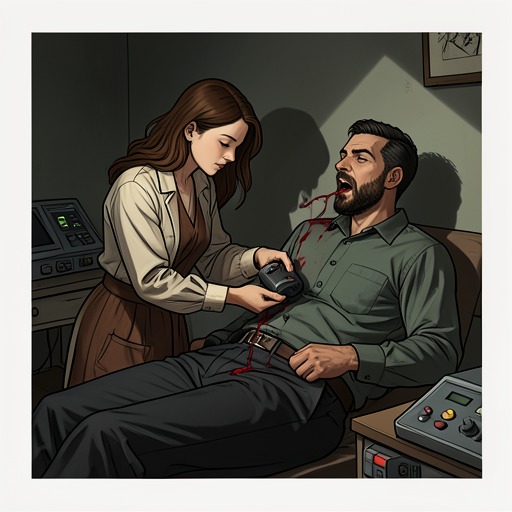
The Primal Roar is described as a human equivalent of an explosion, combining screaming, shrieking, and howling. It is not just a sound: the instructions pair it with facial contortions and frenetic bodily movement, so that the operative appears feral and unhinged. The intended transformation is explicit: she must cease to read as a Beauty and become a monster. The passage treats this as a performance with a concrete purpose, not as an expression of an identified emotion.
Repeated camera flashes intensify the disturbance while the operative Roars. The procedure anticipates that most women holding newborns will step aside when approached by a howling, spasmodic, flashing figure. This detail gives the tactic a practical route through a crowd: the spectacle produces space, even among people who are not the principal target. The instructions do not present the Roar as a way to win a confrontation. Its function is to open a brief passage out of immediate danger, and it must stop the instant that danger has passed.
Passing Through the House and Getting Away
Once the operative is free of the immediate threat, the instructions reverse the transformation. As she runs, she resumes the Beauty role, smooths her hair, and uses the sundress scrunched in her pocket to cover a bleeding wound. The abrupt return to an ordinary appearance is part of the escape method: those stampeding to help a powerful man are expected to pay little attention to a dishevelled Beauty they pass in a hallway. Their attention is directed toward him, allowing her appearance to become cover again and, if she is lucky, buying time to flee his house.
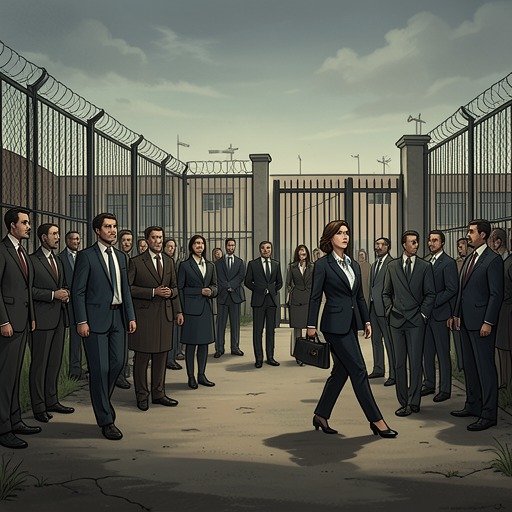
The escape continues beyond the initial distraction. After violence in a closed room, the instructions describe cool night air as clarifying and direct the operative to reach the bottom of a hill by any means, including sliding or rolling. They warn that residences belonging to violent rich men have at least one guard at each exit. In deep night, however, an extremely lucky and quiet escapee may find that guard asleep. The route thus remains uncertain: the Roar creates an opportunity, but getting out still depends on movement, timing, and luck.
At the next threshold, the operative is told to assume the air of a Beauty gambolling carefree. The passage also notes that running barefoot onto a dock may seem to transport her back to childhood, while cautioning that pain may be causing a hallucination. This image marks a shift from the managed spectacle inside the house to an escape experienced through disorientation; it does not resolve the danger so much as register how unstable the operative’s perceptions may be after violence.
Narrative Design and Significance
The event is presented through lessons and instructions rather than through a continuous, conventionally narrated action scene. In the author’s account, the working title was “Lessons Learned,” and the intended shape was to emerge from what the narrator derived at each step instead of from straightforward narration of the action. The fragmented form suits this escape: it breaks a high-pressure sequence into discrete rules, reversals, and cautions, from unleashing the Roar to silencing it, restoring the cover, and looking for a way out.
The author also describes the story as taking a character from a naturalistic work into a different genre, imagining a spy-thriller version of that person. The escape procedure makes that change of genre visible in its techniques: a camera flash becomes part of an improvised diversion, a social identity becomes a disguise that can be put back on while running, and survival depends on exploiting how others interpret appearances. The story was written by hand in a Japanese notebook with eight rectangles on each page and took a year to shape into its final form. That material history echoes the account’s compact, segmented construction without turning the escape into a conventional blow-by-blow scene.